

Selecting the right gate for a commercial property begins with understanding how the entrance needs to function. Security, daily traffic, available space, access control, and architectural appearance all influence which gate system will serve the property effectively.
For Santa Barbara business owners, property managers, and commercial facility operators, a well-planned entrance can help manage vehicles, provide controlled access, and create a professional first impression.
Understanding the differences between sliding gates, swing gates, barrier arms, and access-control systems makes it easier to choose a solution suited to your property's layout, operating requirements, and long-term needs.

Importance of Selecting the Right Gate
Security
A commercial gate provides a controlled point of entry and can help discourage unauthorized vehicle access. Gate construction, materials, height, locking arrangements, and integration with surrounding fencing should be evaluated according to the property's security requirements.
The right configuration also accounts for how employees, visitors, delivery vehicles, and emergency responders will use the entrance.
Access Control
Commercial properties often require controlled access to maintain order and restrict unauthorized entry. Access control determines how authorized vehicles and visitors enter the property. Depending on the system, credentials may include keypads, access cards, remote transmitters, video intercoms, or compatible smartphone-based controls.
For properties with multiple employees, tenants, or delivery schedules, selecting the appropriate access technology can simplify daily operations and support organized entry management.
Branding
Your gate serves as the first point of contact for visitors, and it can significantly impact your brand image. By selecting a gate that aligns with your company's aesthetics and values, you can create a positive first impression. Whether it's a sleek modern design or a traditional wrought iron gate, the right choice can enhance your commercial property's overall appearance.
Types of Gates for Commercial Properties
Slide Gates
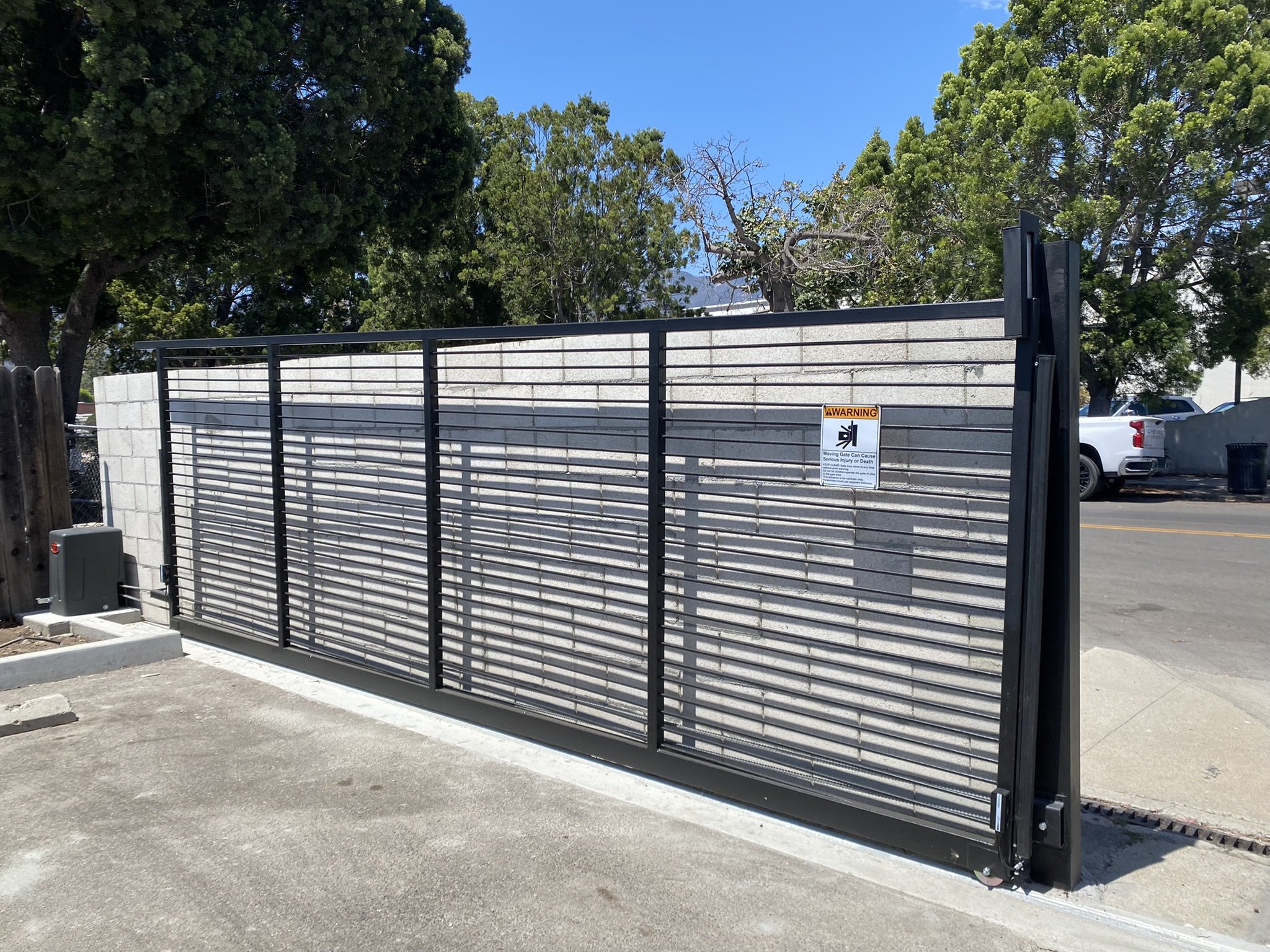
Sliding gates travel horizontally along the entrance and are frequently used where a swinging gate would interfere with driveway circulation or available clearance.
These systems require sufficient lateral space for the gate to open fully. Depending on the installation, the gate may travel along a ground track or operate through another engineered support configuration.
For commercial properties, important considerations include entrance width, grade, traffic frequency, surrounding fencing, and the space required for safe operation.
Swing Gates
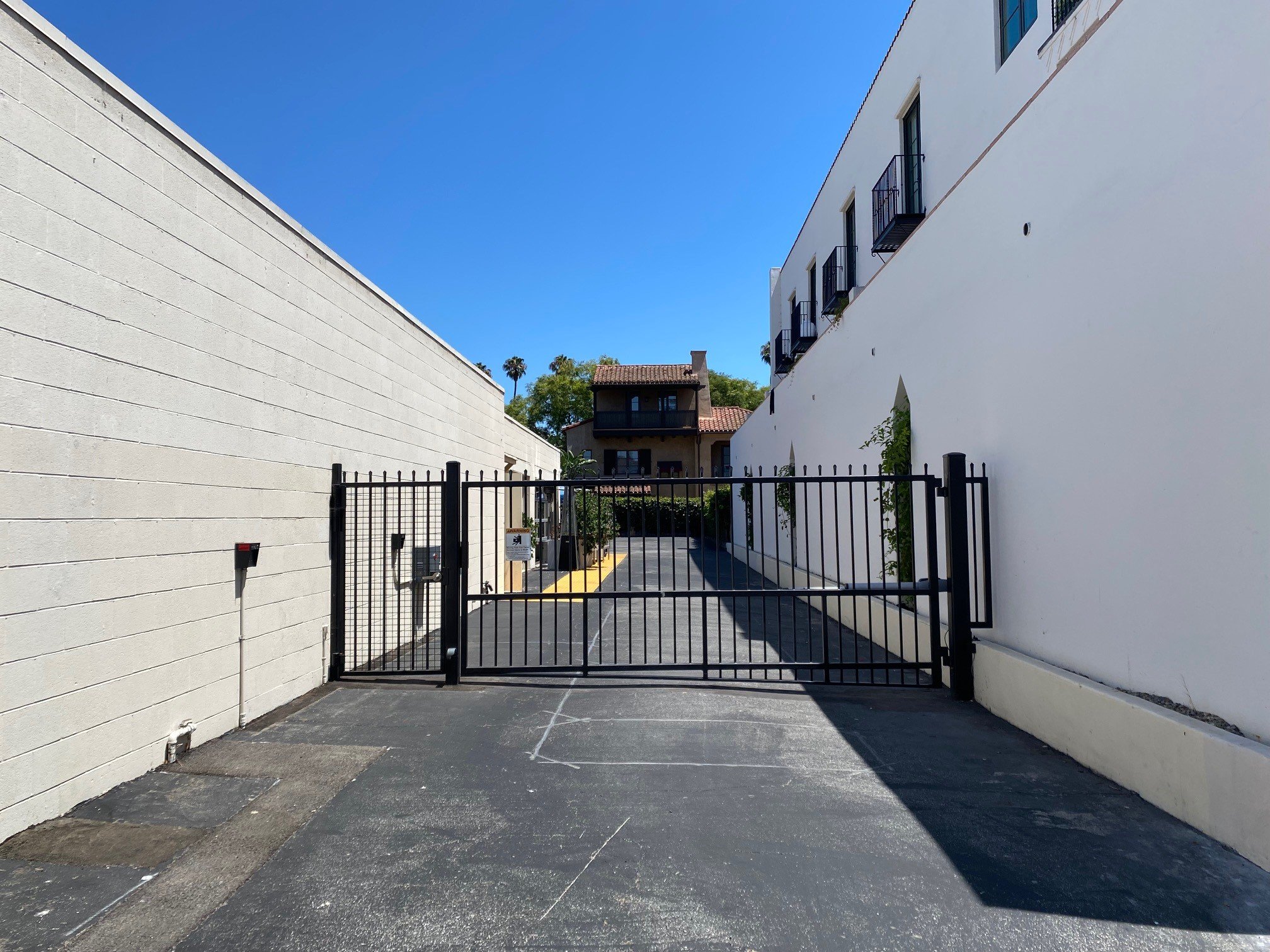
Swing gates offer a traditional entrance appearance and are available in single- or double-leaf configurations. They work well where the property provides adequate room for the gate to travel through its opening and closing arc.
Driveway slope, vehicle positioning, gate dimensions, and nearby structures all influence the appropriate design. Swing gates may also be automated and coordinated with access-control equipment.
Barrier Gates
Barrier-arm systems are commonly used at parking facilities, managed entrances, and commercial properties where controlling vehicle movement is the primary objective.
Their lifting arms can help regulate access and organize traffic flow, particularly when integrated with compatible entry controls. Because a barrier arm primarily manages vehicle passage, properties requiring a secured perimeter may benefit from a different gate configuration or additional security measures.
Access Control Options for Commercial Gates
Keycard Readers
Keycard and compatible credential readers provide an organized way to manage access for employees, tenants, or other authorized users.
Depending on the system, property managers may be able to assign credentials, modify permissions, and maintain records of entry activity. Available features vary according to the equipment and supporting software selected
Biometric Scanners, Keypads, Video Entry, and Connected Access
Commercial gate systems can also incorporate entry keypads, telephone and video intercoms, remote transmitters, and compatible smartphone-controlled access.
Biometric scanners, such as fingerprint or facial recognition systems, offer a high level of security and accuracy. These access control options eliminate the need for physical keys or cards and ensure only authorized personnel can enter the premises.
Video entry systems are particularly useful when visitors need to communicate with a property manager or authorized occupant before entering. Keypads may serve properties that rely on assigned access codes, while connected systems can offer additional control and monitoring features.

Selecting the right combination depends on the number of users, visitor traffic, available connectivity, security policies, and the property's operating requirements.
By considering the importance of these aspects, you can narrow down your options.
Commercial Gate Safety and Installation Considerations
A commercial gate should be planned as a complete operating system. Gate construction, movement, automation, safety devices, and access controls must work together.
For automated vehicular gates, important safety considerations include appropriate entrapment protection, suitable gate operators, required warning signs, and separate pedestrian access arrangements.
Industry standards such as ASTM F2200 and UL 325 provide important requirements for automated vehicular gate construction and operator safety. An experienced gate professional can help evaluate the applicable requirements and the specific conditions at your property.
Visit the Door & Access Systems Manufacturers Association - DASMA for more safety details.
Questions to Consider Before Choosing a Commercial Gate
A productive gate consultation begins with understanding the property's daily operations.
Consider these questions:
How many vehicles use the entrance during a typical day?
Is there enough clearance for a sliding or swinging gate?
Will employees, tenants, visitors, or delivery drivers require different access arrangements?
Where will pedestrians enter the property?
What power, communication, and emergency-access provisions are required?
How will coastal exposure, drainage, maintenance, and long-term operation influence the selection?
Answering these questions helps establish a clearer project scope and supports a gate recommendation tailored to the property.
Commercial Gate Selection FAQs
Which gate is best for a commercial property?
The best choice depends on entrance dimensions, available operating space, traffic patterns, security requirements, and desired access controls. Sliding, swinging, and barrier-arm systems serve different property needs.
Can commercial gates be automated?
Many commercial sliding and swing gates can be equipped with compatible operators. Barrier-arm systems also support automated vehicle access. Equipment selection should account for the gate's design, usage demands, and applicable safety requirements.
What access-control options are available for commercial gates?
Common choices include keypads, access credentials, remote transmitters, telephone/video intercoms, and connected entry systems. Available features depend on the equipment selected and the property's operating requirements.
Plan Your Commercial Gate With Confidence
Choosing the right commercial gate involves balancing security, traffic movement, access technology, architectural design, and long-term reliability.
Consolidated Overhead Door & Gate has roots in Santa Barbara dating to 1958. Our team works with commercial property owners and managers to evaluate gate configurations, automation options, and access-control systems suited to their individual properties.
Explore our Gate Services and Gate Portfolio to learn more about the available possibilities.
Contact our team online or Call Consolidated Overhead Door & Gate at (805) 965-0539 to discuss your commercial gate project with our experienced representatives.